 Sir Francis Drake History
The Voyage Around the World 1577-1580
Pacific Coast Raids on Spanish Treasure Ships
and Discovery of California
 With more ships
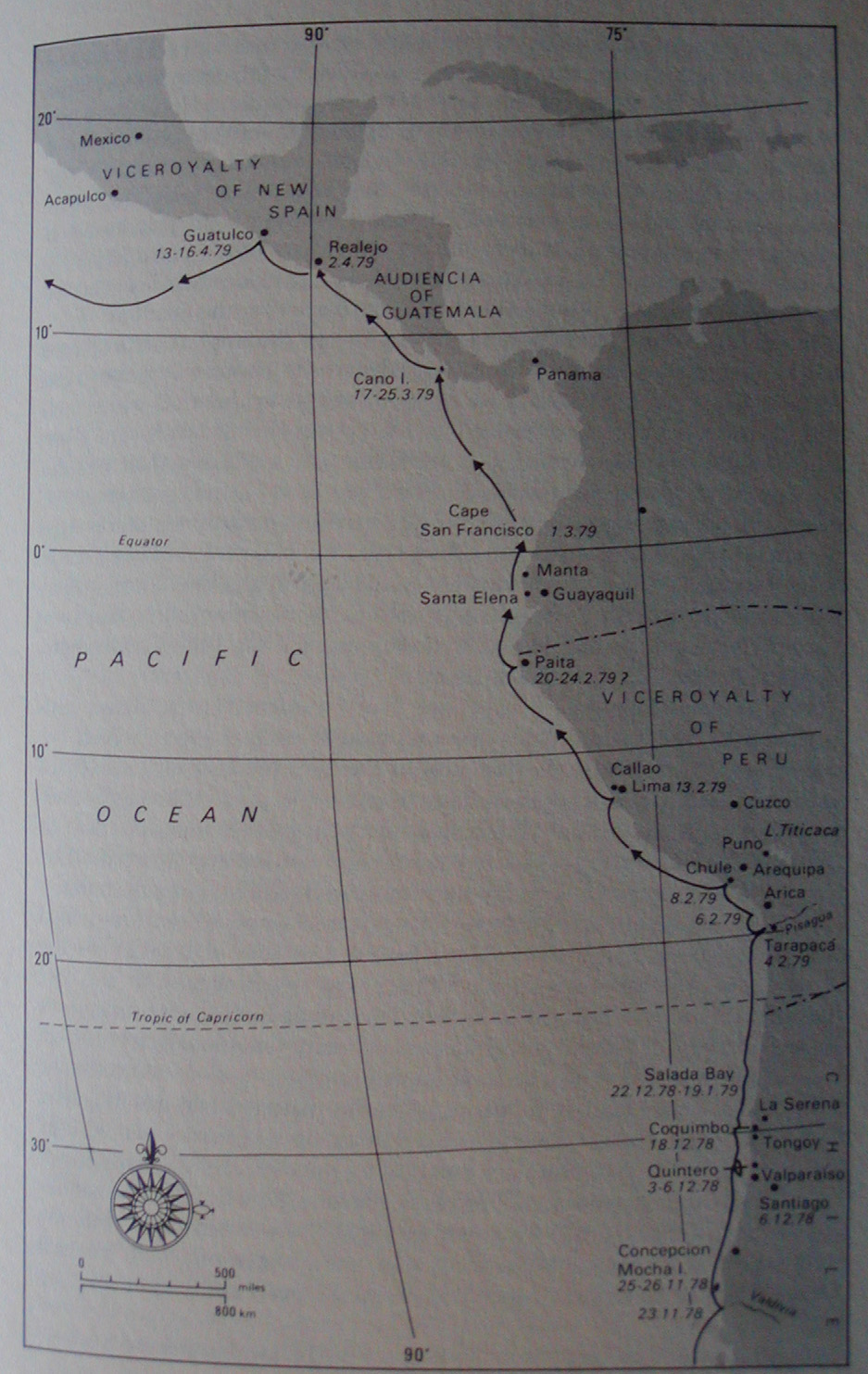
than available sailors to man them, Drake decided to reduce the size of his fleet by burning the "Mary". The three remaining ships "Pelican", "Elizabeth", and "Marigold" sailed from Port St. Julian on August 17, 1578 and then entered the Straits of Magellan. With amazing speed, Drake's three ships passed the treacherous entrence to the Pacific Ocean in 14 days.
Magellan's original passage of which took 38 days. Sailing through the Straights of Magellan was the easy part. According to Drake biographer, Henry R. Wagner, on September 6th, 1578 the expedition sailed
into the Pacific Ocean and met terrible and fierce storms. Nunho Da Silva, the captured Portuguese pilot, noted in his diary, that the ship was blown in a southern direction.
"The Marigold" was presumed destroyed while the "Pelican" searched for a rendevous with "Elizabeth" at 30 degrees latitude.
Captain Winter, who piloted "Elizabeth" turned back to England thinking the other two
ships had perished. Drake got a break in the weather on October 24th and began sailing north.
Fresh food and potable water were scarce on the ship, which had now been re-named "The Golden Hind" in honor of one of the financial
backer's Sir Christopher Hatton. The mutineer Drake had executed, Thomas Doughty, had been Sir Hatton’s personal secretary so Drake was probably trying minimize the repercussions of having Doughty executed by honoring Hatton’s name.
A landing on the Chilean coast to search for provisions was met with an attack by
natives who believed Drake and his men were a hostile force. Turning north, Drake sailed to Valpariaso and took 25,000 pesos of gold from a ship in the harbor and went ashore to find the Spanish dwelling abandoned. The crew took
what they want in food and church silverware and managed to pick up a pilot who knew the coastline. Arica was the next coastal town where Drake found two barks or ships in the harbor and took 37 bars of silver but the Spanish now sent
couriers up the coastline and warned off a threat on the water and element of suprise on these coastal towns would be gone.The next stop Callao, Drake captured a ship whose captain said a large treasure galleon, "Cacafuego", just left on way to Panama. To prevent being followed, the English cut all cables on ships
in the harbor and toppled the masts of the two largest ships. Another Spanish ship "San Cristobal" arrived from Panama with trading goods and Drake helped himself to her goods but the Viceroy Of Peru amassed 200 armed men and two ships and set off after Drake. Drake took another ship with 80 pounds of gold and found the "Cacafuego" was only 2 days ahead. Drake offered a gold chain to the 1st person to see the ship. Drake’s cousin saw the ship on March 1 and set out a ruse to trick the Spanish pilot San Juan de Anton that the "Golden Hind" was another Spanish trading vessel. Drake took his sails in and dragged water casks behind to slow the ship thus making it appear he was lazily traveling to currents and in no hurry to overtake her. Drake got close and sent his pinnace to climb the "Cacafuego" sides and bring back the captain. The prize was tremendous. 13 chest of silver coins, 80 pounds of gold, and 26 tons of silver bars plus a small amount of unregistered silver coin.
Sailing further north on April 4, 1579 Drake captured a ship owned by Don Francisco de Zarate and picked up 4 chest of Chinese porcelin, silks,
and a female black slave. Zarate is let go but his interrogation by the Viceroy of Mexico provides an account of Drake and his men.
The last port of call was Guatulco, a small Mexican port, where Drake’s men took the store of food and the contents of a
Roman Catholic church including the bell from the belfry.
Nuno da Silva was let go and told Spanish interregators he thought would continue following the coast in search of the fabled Northwest
Passage back to Europe and if he does not find it he will go home by way of China.
Drake found a secluded bay at 38 degrees latitude near present day San Francisco where his men repaired the keel of his boat the "Golden Hind".

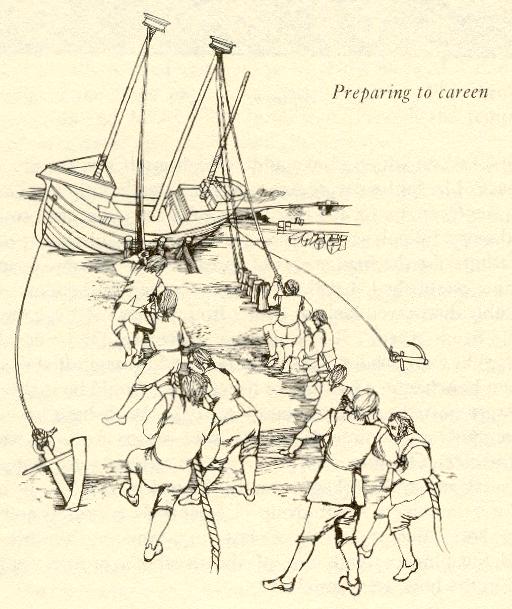 "Careening" is the nautical terms for hauling the ship
up on shore with ropes and beginning the repair process. The sails and rigging
were repaired and the hull was scraped, caulked and a coating of tar was applied.
These repairs were absolutely necessary as the long voyage across the Pacific
would test the ships endurance. The sailors got chance to rest, eat fresh fruit
that cured the scurvy which early explorers were known to suffer from. After Drake landed in California,
the English encountered indigenous Miwok Indians. The Miwoks
regarded Drake and his men as divine gods from the sea but this was blasphemous to Drake and tried to introduce the
Miwoks to Christianity. Francis Fletcher, the ship's chaplain, noted the Miwoks collected shellfish, hunted local animals, caught fish and sea lions with nets and spears and ate a paste made from
crushed acorns. Drake reportedly posted a plaque claiming the land “Nova Albion”
(Latin for “New England”) for Queen Elizabeth. After careening the ship,
Drake sailed to the Farrallon Islands off the coast of California before
embarking across the Pacific Ocean on July 26th, 1579.
Welcome to SirFrancisDrakeHistory.net-Page 1
Drake Receives Approval from Queen Elizabeth for a World Circling Voyage-Page 2
Drake Sails across Pacific Ocean and returns to England-page 4
Links to Web Pages and photos of "Golden Hind" replica ship being built
E-mail your comments/suggestions